
my friend, the abyss
on insomnia, postpartum psychosis, and the known

Dear friends and comrades,
I haven’t been sleeping well, but it’s not the baby’s fault. It’s my own! In case you haven’t been paying attention the last 40 years, I’m a lifelong insomniac. Not a problem that people usually have compassion for. Like, what, you just keep yourself awake? That’s… your own fault? I should have figured this out myself, I hear, and definitely years ago. Like many chronic illnesses and disabilities, it is embarrassing (though many books convey the widespread and politicized nature of insomnia). How embarrassing to have a problem I should be capable of solving on my own. How embarrassing to need help over and over again.
Enter baby, though, and suddenly people have wells of compassion for exhaustion. Oh, you’re tired! Of course! You’re a new parent! I am suddenly deserving of my tiredness, having earned it through reproduction, I guess. Yet another situation I’ve noticed in which reproduction brings legitimacy to a form of suffering that is not viewed as such without a a child.
It’s very tempting to accept the narrative that I am, pobrecita, pitiably and understandably tired now, after years of just seeming unhinged after 2pm. It’s tempting to portray myself as a victim of my baby’s sleep. But this is one way the baby and I are now two separate beings. My baby sleeps pretty well. We have pretty distinct experiences of nighttime.
I’ve been thinking about when the baby is an excuse, when the baby has nothing to do with it, and when the baby is a gateway drug to horror. By which I mean: the circumstance that makes you look too far off the cliff into the abyss. In Emily McBride’s forthcoming novel Queen Mab, I felt the subtlety of this distinction.
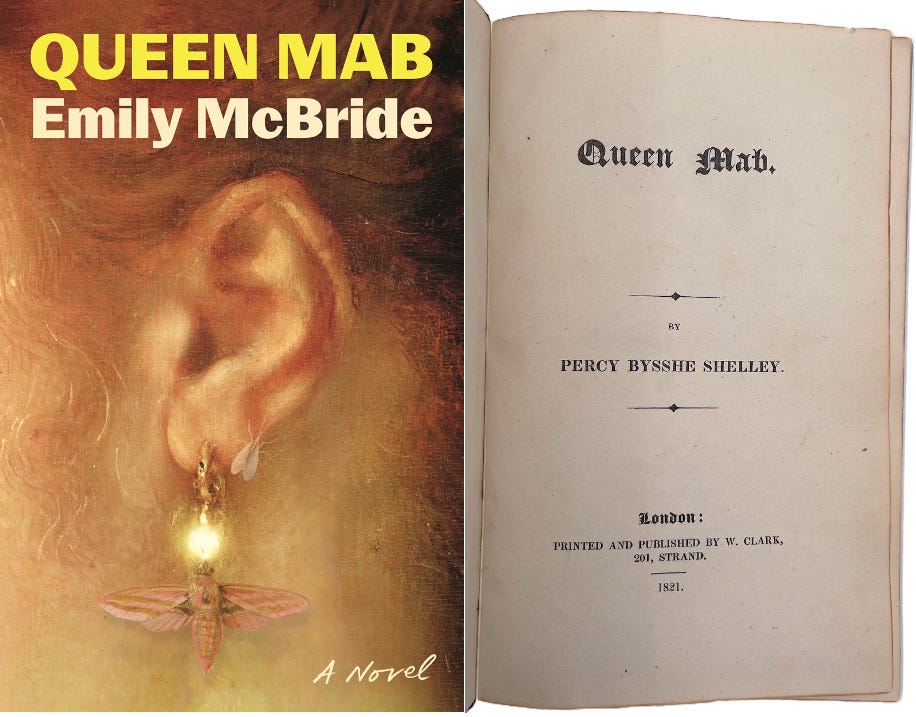
In Queen Mab, Madeleine, a young literature student, has a baby and, at first, seems just miserable. Initially, the book wasn’t doing it for me: I am easily bored by books about miserable early motherhood, even though I’m currently their target audience. As the book unfolds, Madeleine becomes immersed in ideas of the fairy world she knows from literature. She is increasingly convinced that the fairy world is her own, and her infant not her own, but rather a changeling left behind by fairies who have kidnapped her true infant.
Here the book lit up for me — a sleep-deprived parent alone with a baby much of the time peers in the abyss, and the abyss is excellent company. Our minds turn to the frameworks most available to hold us. We take what we can get.
Sure, the book is a moving portrait of postpartum mental illness. But it walks an edge: the edge acknowledging that mental illness is full of suffering but at the same time can present realities that comfort us, explain us to ourselves, or make a kind of sense of something that does not otherwise make any.
Queen Mab often reminded me of Elizabeth Sankey’s thoughtful documentary Witches (recommended to me by the brilliant artist Jessica Bardsley, currently at work on her own film about night). Witches invokes historical witches to better convey the experience of postpartum psychosis, anxiety and depression. The women in the film are less alone because of Sankey’s link to the witches. Again, an offering of structure, an alternate sense-making. A framework of magic that takes hold when little else is available for holding.
I also love that Witches does not convey mental illness as completely disappearing, even for those people in the film who receive excellent and “successful” treatment. The film leaves literal images around the edges of its frames that indicate the residue remaining in people’s lives even after their treatment.
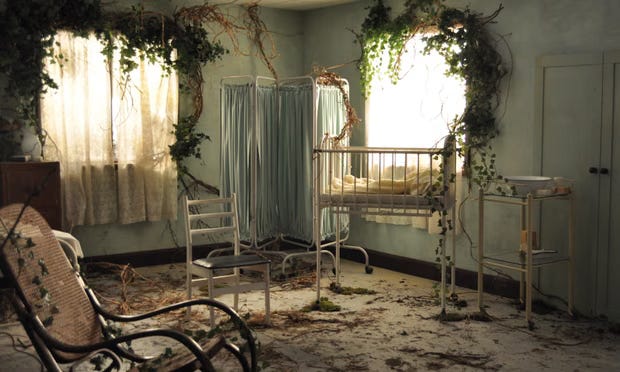
Without real spoilers, I can say that Queen Mab ends in a similar spirit: the residue remains, but Madeleine has decided to live in the non-fairy world. She has been provided with sufficient structural and relational support to prioritize the non-fairy world. And so the beckoning of that magical world is lessened.
Though I haven’t myself suffered from a significant postpartum mental health crisis, I know many people who have. I have gone to support groups held by the Motherhood Center to find company with those who share some of the specificities of my child’s birth. I strongly recommend the work Dr. Jessica Vernon, who you can meet through her book. I was lucky to have Dr. Vernon deliver my baby.
I’ve never experienced the kind of reality departure we witness in Queen Mab, but I can relate to how Madeleine takes refuge in literary forms she knows during a time of drastic change. I’ve had a lot of support postpartum to remain connected to my friends and job and practices, but I still sometimes find myself grabbing frenetically at something I used to know, trying to prove that it is familiar to me, even if the angle from which I am grabbing has shifted.
I mean, here I am writing about books and films, writing this newsletter, though its form has shifted and I find my language more blunt and direct than it used to be. I seek to find myself in the worlds that offer sense-making to me.
I think it’s a crucial and loving act to normalize the desperation with which we grip for something to frame and surround us. Yes, I love negative capability as much as the poet, but because I live in a social world, I don’t live in the void or the mystical all the time. I touch into it when I feel I am strong enough to come back.
Sometimes the abyss is there when people can’t be. Sometimes the abyss is there when health care is not, or when even books are too hard too read. My child is nearly 10 months old, and I am only at the very beginning of learning where parenthood stretches me. Sometimes magic is what makes the most sense to explain my good sleeper child: I genuinely believe that the suddenness and violence of my child’s birth cut and interrupted a long ancestral line of anxiety and sleeplessness. You don’t have to agree with me on this—it is meaning-making that is functional for me.
You might find yourself more forgiving, too, of my magical thinking because it involves birth and parenting. I have found that is the case for many who are skeptical otherwise. I’m interested in how this forgiving quality can dilate, swell, elaborate itself into a more forgiving generosity elsewhere. How might our generosity with new parents expand us to feel generous beyond parenting? How might a compassion for maternal mental illness also offer legitimacy to experiences of mental illness otherwise?
I’m not interested in parenting being an excuse, but I am interested in it as a gateway to amplified understanding. To that end, I’m glad to share some writing in the first issue of Care Making, a zine on artistic practice and family making. Save the date for July 12, when we’ll gather in Brooklyn to celebrate the zine’s release and I’ll lead a brief conversation about making across forms.
Lastly, hope you’ll join me for Krys Malcolm Belc’s book launch on June 29 at Books are Magic. I’ve said enough about what I love about this book, and I’m excited to hear Krys speak for himself.
Thank you for reading,
Leora
ps. I know at times I’ve offered recipes here, but I’ve already shared about my scramble to reconnect with cooking postpartum. So for now I’ll leave you with a recipe for batch martinis. Highly recommend bringing a jug of these and a shaker of ice to your park picnic. Your friends will think you have it way more together than you do.